
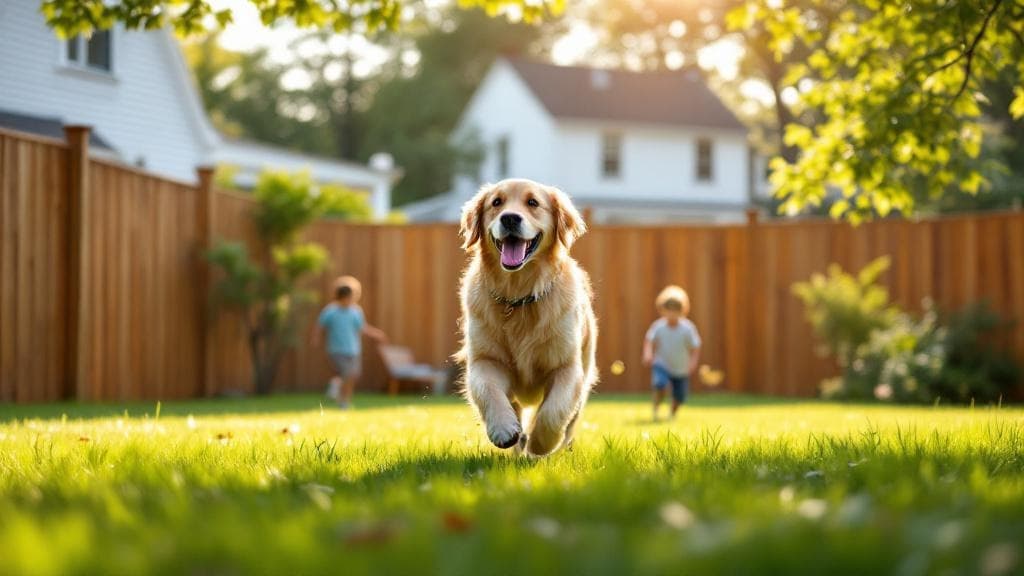
Escape artists, diggers, and jumpers each need a different solution. Here's how NH homeowners are solving each type of problem — and what to watch for on uneven terrain.
Dog owners make up a big percentage of fence customers in Southern NH — and for good reason. A yard that isn't fenced is a yard a dog can't safely use. But not every fence works for every dog. The right choice depends on your dog's size, temperament, and whether they're a jumper, a digger, or an escape artist who finds creative solutions.
Know Your Dog's Escape Style First
- Jumpers: dogs that clear fences by jumping require minimum 5–6 foot height — sometimes more for large athletic breeds like huskies, labs, and shepherds
- Climbers: dogs that climb chain link need smooth-sided fencing (vinyl, wood) without footholds
- Diggers: dogs that tunnel under require a concrete footer, buried hardware cloth, or a concrete/compacted gravel trench below the fence line
- Gap finders: dogs that squeeze through gaps need tight spacing — no more than 2 inches between boards or pickets for medium/large dogs
- Fence fighters: dogs that throw themselves at the fence and stress the structure need a system built to handle serious impact
Best Fence Options by Dog Type
For Most Dogs: Wood Privacy Fence
A 5 or 6-foot wood privacy fence — dog-ear or board-on-board cedar — is the most popular dog containment choice in Southern NH for a reason. It's solid, blocks sight lines (which reduces fence-reactive behavior), doesn't provide footholds for climbers, and looks great. With pressure-treated posts set below the frost line and boards installed tight to the ground, it contains most dogs effectively.
For Diggers: Buried Hardware Cloth or Concrete Footer
If your dog digs, the above-ground fence doesn't matter — they'll go under it. The solution is a continuous L-shaped hardware cloth apron buried 6–12 inches underground, extending 12 inches outward from the fence base. When the dog digs down, they hit the barrier and give up. On very serious diggers or around pool barriers, a concrete footer at the base is the more permanent solution.
For High Jumpers: 6-Foot Minimum, Consider Coyote Rollers
A 5-foot fence won't hold a motivated husky or German shepherd. 6-foot privacy or vinyl is the minimum for athletic jumpers. For extreme jumpers, coyote rollers (horizontal rotating tubes mounted on top of the fence) prevent the dog from getting purchase at the top — they can't grip and pull themselves over. These work on wood, vinyl, and chain link.
For Small Dogs: Watch the Gaps
Small breeds can squeeze through surprisingly small gaps. A standard 4-foot privacy fence with boards installed tight is usually fine, but check for gaps at the bottom on uneven terrain. A 4-inch gap that looks minor to you is an exit route for a Yorkie. If your yard has grade changes, make sure your contractor accounts for it — boards should follow the grade, not leave open triangular gaps at the low spots.
Uneven Terrain: The NH-Specific Problem
A lot of Southern NH yards aren't flat. Lots that slope, drop off, or have grade changes create natural escape routes if the fence doesn't account for them. The best dog fences on sloped terrain use one of two techniques: stepping (fence follows a stair-step pattern down the slope) or raking (fence follows the grade at a continuous angle). Both can be effective for dog containment, but stepping leaves small triangular gaps at each step that need to be filled.
Chain Link: Pros and Cons for Dogs
Chain link is practical and less expensive than wood or vinyl, but it has real drawbacks for dogs. Most dogs can climb chain link if motivated — it's a natural ladder. It also doesn't block sight lines, which can increase fence reactivity and frustrated barrier behavior. That said, for a dog run, exercise area, or large property where looks are secondary to function, chain link with adequate height and a concrete footer is a solid choice.
Gates Are Where Dog Fences Fail
The fence can be perfect and the gate can undo everything. Dog-proof gates need: self-closing hinges, a latch the dog can't nudge open, and a gap-free bottom. We install gravity latches or spring latches on dog-containment gates specifically because standard handle latches are often too easy for a determined large dog to manipulate.
We'll walk the yard with your dog in mind.
Before we quote, we walk every foot of the fence line, check grade changes, and ask about your dog. We've contained labs, huskies, mastiffs, and everything in between.
Get a Free EstimateSources
- What Type of Dog Fence Is Best for Me and My Dog? (American Kennel Club)
- Coyote Roller, the rolling fence-top bar system for jumpers and climbers (manufacturer site)