
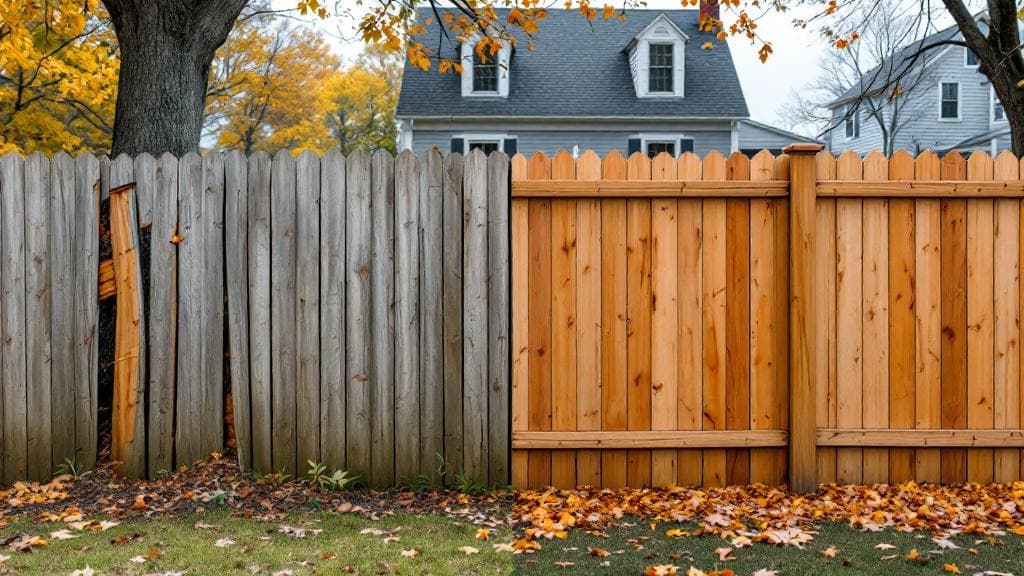
A leaning fence isn't always a dead fence. Here's how to assess what you're actually dealing with — and when repair makes financial sense vs. when you're throwing money at a losing cause.
After a hard NH winter — or after years of deferred maintenance — a fence can look pretty rough. Before you call a contractor and assume you need to start over, it's worth understanding what the actual problem is. Sometimes a modest post repair buys you 10 more years. Sometimes that same repair only buys you 18 months on a fence that's already failing everywhere.
The Single Most Important Assessment: The Posts
The posts are the foundation of your fence. Everything else — rails, boards, panels — is secondary. When you're evaluating a damaged or aging fence, start with the posts:
- Push on the post firmly at mid-height. Does it move? If yes, it's either rotted at the base, the concrete has separated, or it was never set deep enough.
- Check the base where the post meets the ground. Probe with a screwdriver or awl — if it sinks into the wood easily, the post is rotted.
- Look at the concrete collar if visible. Has it separated from the post, leaving a gap where water gets in?
- Check for lean — a post that's leaning away from plumb is usually heaving (shallow set) or rotting at grade.
When Repair Makes Sense
Isolated post failure
If 1–3 posts out of a 100-foot fence run are rotted or heaving, and the rest of the posts are solid, targeted post replacement is almost always the right call. Pull the bad posts, reset them below frost line, re-attach the rails and boards. You get another 15–20 years out of the rest of the fence.
Storm damage to boards or rails
If a storm blew down a section — boards stripped off, a rail snapped — but the posts are still solid and plumb, this is pure repair territory. Replacing boards and rails is straightforward work and doesn't require touching the rest of the fence.
Gate problems
A gate that won't latch, swings poorly, or sags is almost always repairable. Gate issues are usually a hinge adjustment, a post reset on the hinge side, or hardware replacement. A gate replacement is rarely necessary unless the gate frame itself is rotted or severely damaged.
When Replacement Makes More Sense
Widespread post rot
If more than 30–40% of the posts are rotted at grade, you're looking at a fence that's going to keep failing one post at a time. At that point, the labor cost of progressive repairs over 3–5 years will exceed the cost of pulling the fence and starting fresh. A new fence with properly treated posts and proper depth will outlast the repair cycle.
Posts set too shallow
If your fence is heaving every year and the posts were clearly set too shallow — a common problem with older installs and budget contractors — you can reset them one by one, but you'll likely find yourself doing it repeatedly. If the original post depth was 18–24 inches throughout, a full reset at proper depth is usually more cost-effective long-term.
Material failure throughout
Cheap vinyl that has gone brittle, pressure-treated lumber that was the wrong retention level and has failed throughout, or galvanized chain link that has rusted through — these aren't repair situations. The material itself has reached end of life, and patching individual sections is just delaying the inevitable.
How to Get an Honest Assessment
Any contractor worth working with will tell you honestly whether your fence is repairable or needs replacement — and why. Be skeptical of a contractor who immediately recommends full replacement without explaining the post condition. Be equally skeptical of a contractor who agrees to repair a fence that's clearly failing throughout just to get the job.
Ask to see the posts that are being identified as the problem. Ask what the contractor expects the life of the repair to be. Get it in writing.
Not sure what you're dealing with?
We'll come out and give you an honest assessment — repair or replace, and exactly why. We don't upsell replacement when repair is the right answer.
Schedule a Free AssessmentSources
- Treated wood Use Categories for homeowners, including ground contact ratings (American Wood Protection Association)
- QUIKRETE Concrete Mix data sheet: method for setting fence posts (PDF, The Quikrete Companies)