
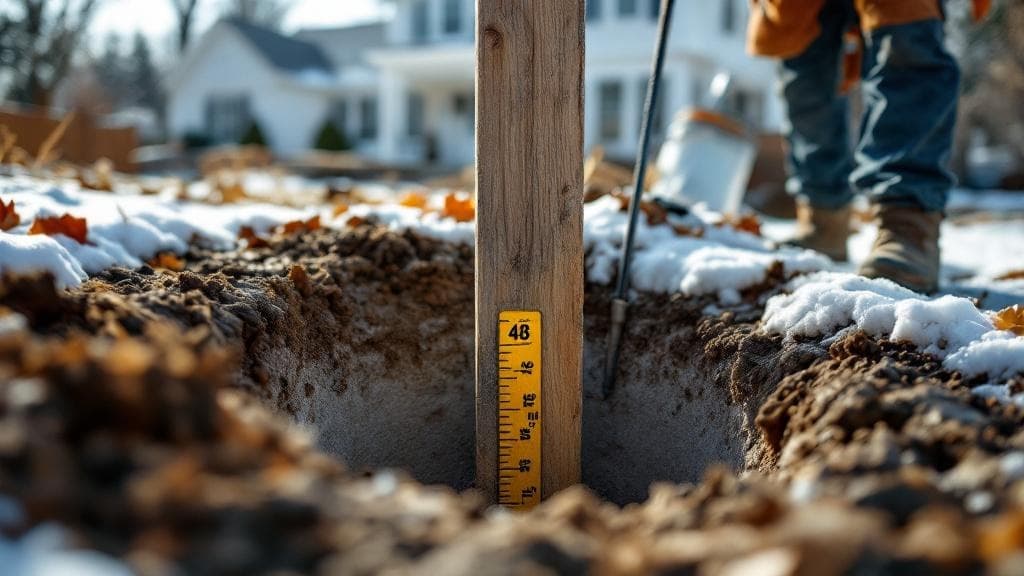
In New Hampshire the ground freezes deep, and posts that don't reach below the frost line heave every spring. Get post depth wrong and you'll be resetting your fence every winter. Here's how to do it right the first time.
This is the single question that separates a fence that lasts 20 years from one that leans, heaves, and fails within three. In New Hampshire, the ground freezes deep — and if your fence posts don't go below that freeze line, the expanding soil will push them out of the ground every single winter.
Why NH's Frost Line Runs Deep
New Hampshire's frost line runs deep, and the exact depth varies by town and elevation. It's the level the ground is expected to freeze to during a severe winter. Posts that stop above the frost line sit in soil that cycles between frozen and thawed each season. That cycle exerts enormous upward pressure on anything buried in it — a process called frost heave.
Note: frost depth isn't uniform across the state — some coastal towns (Portsmouth, Hampton, Rye) freeze a little shallower than inland and northern areas. Always check with your local building department for the depth that applies to your property, and when in doubt, go deeper.
While you have the building department on the phone, ask whether your project needs a permit. Rules change town to town, and our NH fence permit guide breaks down what each town requires.
What Frost Heave Actually Does to a Fence
Frost heave doesn't just push a post slightly off level. Over two or three winters, it can raise a post 3–4 inches out of the ground. When one post heaves and the adjacent posts don't, the fence section between them torques, the rails crack or separate, and gates fall completely out of alignment. By spring, what looked like a solid fence in October looks like a war casualty.
The Right Way to Set a Post in NH
- Dig below the local frost line — deeper if you're on high ground or in the northern part of the state
- Add 4–6 inches of crushed stone (3/4-inch gravel) at the bottom for drainage — standing water at the base rots wood and accelerates heave on concrete
- Set the post and brace it plumb
- Pour concrete around the post, slightly crowning the top so water drains away from the base rather than pooling
- Let concrete cure for at least 24 hours before attaching rails and panels — ideally 48 hours in cold weather
Use Only Ground-Contact Rated Pressure-Treated Lumber
In-ground fence posts must be ground-contact rated pressure-treated lumber. Check the end tag on the wood: it should show AWPA Use Category UC4A or higher, which older stamps mark as a .40 or .60 retention level. Above-ground rated lumber or standard untreated lumber will rot within 5 to 7 years when buried, even with concrete. Most fence failures we see from other installers come from posts set at the wrong depth, wrong lumber grade, or both.
Why Contractors Cut Corners on Post Depth
Digging below the frost line in New Hampshire is hard work, especially in granite soil or ledge. A contractor who sets posts shallow can quote you less, get the job done faster, and the fence looks identical on day one. But 18 months later — after two freeze-thaw cycles — that fence starts to move. By year three, you're calling someone to fix it.
The only way to verify post depth is to ask your contractor directly and check your contract. Our written estimates specify post depth explicitly. If a contractor won't put it in writing, that's your answer.
What About Rocky Soil and Ledge?
Southern NH has significant ledge in many areas, particularly in Londonderry, Hollis, Amherst, and the hillier parts of Nashua. When ledge prevents a full-depth hole, experienced installers use surface-mount post brackets set in concrete above the ledge, or drill into the ledge itself with a masonry bit. The right solution depends on how close to the surface the ledge is. This is why a walkthrough before quoting matters — not every yard is the same.
We set every post below the frost line.
Our written estimates specify post depth, lumber grade, and concrete spec. If you've had a fence heave before, we can explain exactly why — and how we do it differently.
Get a Written EstimateSources
- NH RSA 155-A, New Hampshire Building Code (adopts the International Residential Code 2021, which sets frost protection requirements for footings) (NH General Court)
- Treated wood Use Categories for homeowners, including UC4A ground contact (American Wood Protection Association)
- QUIKRETE Concrete Mix data sheet: method for setting fence posts, cure times, and freeze protection (PDF, The Quikrete Companies)